Can you search ChatGPT chats across two accounts?
Not with ChatGPT. It can keep two accounts signed in at once, but it shows, and searches, one at a time, and OpenAI's help page says switching does not share conversation history. Hubort is a Windows app that reads the chats of every ChatGPT account you sync, on your own computer, and searches all of them at once. Every result shows which account it came from.
OpenAI's page was read on 6 October 2026.
Can I search ChatGPT across my accounts?
No. OpenAI's help page, Use multiple accounts with account switching, describes a switcher that lets you be signed in to a work account and a personal one in the same browser. It describes what that does and does not do:
“Switching is not merging. Switching does not:
- Move chats between accounts
- Share memory or conversation history
- Share files or uploads
- Combine billing or subscriptions
- Merge workspaces”
The page describes no search over both. What it describes is the opposite: “When you switch, all chats, memory, files and settings will reflect the selected account.” So the chat you want is in one of your accounts, and you find out which by switching and looking.
Why isn't the chat I want where I'm looking?
Because two accounts that look alike are separate, and the page spells out the limits that make it easy to be in the wrong one.
- Only one is active at a time. The page says: “Only one account is active at a time, but switching is immediate.” Everything you see, including the sidebar's list of chats, belongs to that one, and nothing in it hints at the chats you started in the other.
- The switcher holds two. “You can have a maximum of two accounts active in the switcher per session.” A third account, a school one or an old one, means logging out of one of the others, and its chats are out of reach until you log back in.
- It is not everywhere. The page says account switching is available on ChatGPT on the web, and “is not yet supported in Codex desktop or the native ChatGPT mobile apps.” So the way the page describes to keep two accounts at hand doesn't cover where some of your chats may have started.
The page's own advice for telling them apart is a small one: if you're unsure which account you're using, check the active account shown in the account menu. That tells you where you are, not where the chat is.
What do people try instead, and why does each fall short?
Three things, and none of them gives you one search. Each does something useful; none of them makes two accounts searchable together.
- Switching and searching in each. It works, one account at a time. You have to remember to do it, and you have to remember the chat was in a ChatGPT account and not in something else.
- One browser profile per account. It keeps the sign-ins apart, which is why Hubort asks for one extension per profile. The chats stay where they are, so on its own it is still one account at a time.
- Pasting the good chats into notes. It catches the chats you thought to save. The one you needed was never going to be one of them.
How does Hubort search ChatGPT across accounts?
Hubort is two installs: a Windows app, where your chats live and where you search them, and an extension for each browser profile you use AI in. The extension reads your ChatGPT chats with the session you are already signed in with in that browser and hands them to the app. You name each account (“Work”, “Personal”), and one search box then covers all of them, each result in its own account's colour, next to your Claude, Gemini and Grok chats if you sync those too.
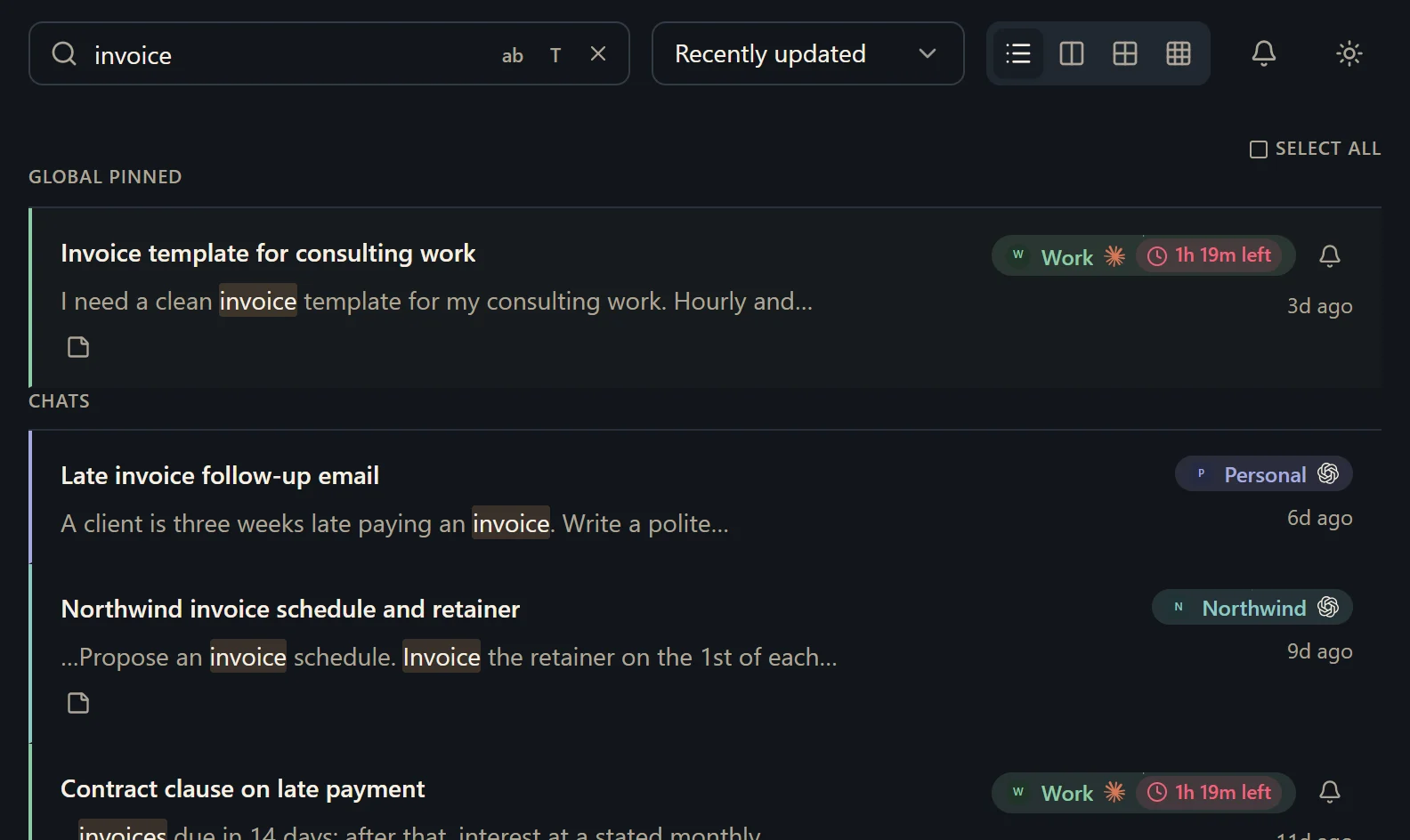
Nothing goes to a server of ours, because there isn't one: the chats sit in a database on your own computer, which you can read with any SQLite tool and export as Markdown whenever you like. Hubort only reads. It never sends, renames, archives or deletes anything in ChatGPT.
What should I know before I try it?
It is Windows 10 and 11 only, for now. It is free for two sources. A source is one account on one provider, however many browsers it syncs from. So a work and a personal ChatGPT account are two, and a third is a third. Every install also starts with 14 days of everything, with no card. More accounts start at $4.99 a month, and the pricing page has yearly and buy-once prices.
The first read of a large ChatGPT account takes a while: ChatGPT limits how fast it will answer, so Hubort reads a few chats a minute and backs off when it is asked to, and everything it has read is searchable straight away. If chatgpt.com tells it to slow down, it waits before it tries again.
Two things you should hear from us. The installer is not code-signed yet, so your browser and Windows will each warn you about it, and the download page says exactly what you will see. And Hubort reads each service's web app on a schedule, which may be inconsistent with that service's terms; the privacy policy has the full note, and you can lengthen the interval or untick a service at any time.
How do I try it?
Install the app, then add the extension to each browser you use ChatGPT in. The setup guide walks through every step, and the download page has both.
The same question for other services: Claude, Gemini and Grok.